MORR Strategy - ScORSA Membership Insight
This month, we asked Ross Macdonald, Safety, Security Risk and Compliance Consultant, for his insights.
.png)
Why is it important for organisations to have a clear occupational driving strategy?
Organisations are built on the assumption that people already know how to drive, since most employees have been driving to work and in their daily lives for years. Published research from HSE and the Scottish Government shows that up to a third of all road crashes involve someone who is driving for work (HSE, 2025). Too often, organisations of all sizes either don't acknowledge the risks associated with driving, or fail to control them effectively. The attitude behind this is often some version of "everyone knows what the rules ought to be, they don't need us to tell them again." Actually, they do.
At work, people know that there are rules in place to protect them. They don't need to guess about HR policy, IT security, or uniform standards, because those decisions are taken out of their hands, so they don't distract from the business of doing business. Driving at or for work needs the same treatment. Employees should only ever have the option to do the right thing, which protects them and the organisation at the same time.
What are the biggest challenges organisations face when managing occupational road risk?
The biggest challenge an organisation faces when managing occupational road risk is getting individuals to change their thinking and approach, not the cost of implementation or the effort of moving away from established habits.
When was the last time you met someone who drives at work who thought they were a bad driver, or a careless driver? Every accident, incident or near miss is almost always claimed to be someone else's fault. If everyone were as good a driver as they claim, the incidents simply wouldn't happen at the rate they do.
Many of the rules and processes in place often go unchecked when away from the home base, and very often there will be a culture of under-reporting. The challenge is in embedding a process where everyone chooses to do the right thing every time, even when nobody else is watching.
With SMEs, we then have the added complication of grey fleet, someone using their own car under the belief that it's their car and therefore their rules. All too often organisations do the bare minimum to appear engaged: do you have a licence, do you have business insurance, do you have an MOT, tell us if any of that changes.
Together, we need to do better.
How can effective incident reporting and investigation help improve road safety and prevent future collisions?
Effective incident reporting and investigation - when it becomes commonplace - just opens up the dialogue, it starts the conversation, it removes the fear of what an investigation might mean.
Often an investigation is seen by staff as "here we go, I am going to get in trouble" when in actual fact effective investigation (such as one aligned to Health and Safety Guidance in HSG245 or aligned with ScORSA principles) will point to a root cause, an underlying principle, an overlooked area which allowed the incident to take place.
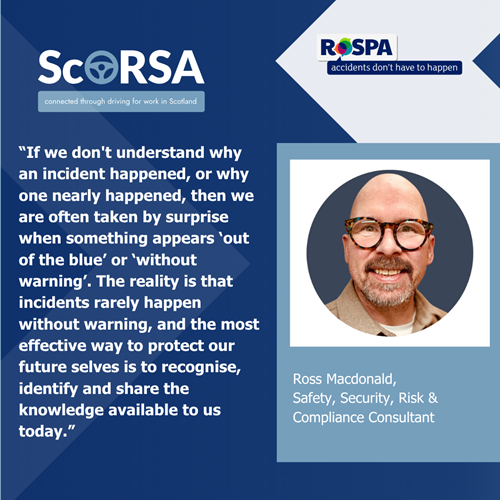
If we don't understand why an incident happened, or why one nearly happened, then we are often taken by surprise when something appears "out of the blue" or "without warning".
The reality is that incidents rarely happen without warning, and the most effective way to protect our future selves is to recognise, identify and share the knowledge available to us today. Share that with the right people - those who can make a difference - and rather than shoulder the stress and worry of something bad potentially happening in the future, we can actually ward that off today.
Put simply: It might feel expensive to do something now. It will feel even more expensive to try and fix things after they have broken.
And by expensive - we don't just mean money. What's the cost of someone never making it home after a day at work?