What Sweden Taught Me About Putting People First
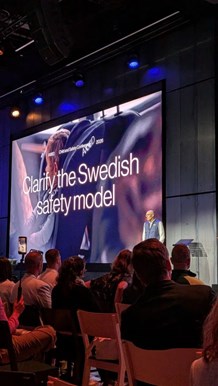
I recently had the opportunity to attend the Axkid Child & Safety Conference in Gothenburg, Sweden, alongside Rebecca Morris, Elizabeth Box, James Luckhurst and Sarah O'Toole.
The conference brought together researchers, clinicians, manufacturers and safety professionals with a shared goal: improving outcomes for children through better design, better research and better understanding of human needs.
Road traffic collisions remain the leading cause of death globally for people aged 5–29. Yet Sweden continues to demonstrate what is possible when safety is approached as a long-term societal commitment. In 2024, the country recorded 213 road deaths, a reduction of around 70% compared to 2000.
The innovations on display were impressive. Axkid shared developments around impact-sensing technology that could identify whether a child seat has been involved in a collision, improving both safety and sustainability. Their virtual safety laboratory demonstrated how advanced human body models are being used to better predict injury outcomes, helping move beyond traditional testing methods and designing for a wider range of real-world users. We also heard about innovations aimed at improving the transfer of critically ill children, helping to improve both the quality and equality of pre-hospital care.
But as fascinating as the technology was, my biggest takeaway wasn't actually about technology at all. It was about people.
Throughout the conference, a common thread seemed to run through every presentation. Whether discussing product development, research, emergency care or education, the starting point was understanding the needs of the people the system was designed to serve.
The focus wasn't simply on meeting standards or achieving compliance. It was on asking better questions. How do people actually behave? Where do mistakes happen? What pressures do they face? How can systems be designed to support them when things don't go to plan?
Too often, organisations focus on procedures, policies and compliance metrics. Those things are incredibly important, but the strongest safety cultures are built when we understand the reality of people's experiences and design work around human needs rather than expecting humans to adapt perfectly to systems.
One phrase that stayed with me throughout the conference was the Swedish approach to safety: keep it simple, understand the real-life customer and design from a genuine human perspective.
Simple principles, but powerful ones. I found myself reflecting on those ideas beyond the conference itself.
Gothenburg was a wonderful city to visit. It felt clean, safe and remarkably calm. Public transport was reliable, people were friendly and considerate, and there seemed to be a strong sense of trust in the systems around them.
Of course, every country has its challenges, and a short visit can never tell the whole story. But it did make me wonder how much safety outcomes are influenced by the wider environments we create.
When systems work well, when people trust them, and when everyday interactions are built on consideration and respect, perhaps that influences behaviour in ways that are difficult to measure but impossible to ignore. Maybe that is one of the lessons we can learn from Sweden.
Health, safety and wellbeing are often discussed as separate disciplines. Yet the more I reflected on the visit, the more they appeared interconnected. Safer people are often healthier people. Healthier people are often better able to make good decisions. People who feel supported and valued are more likely to engage positively with the systems around them.In that sense, safety is not simply about preventing harm. It is about creating environments where people can thrive.
Whether we are designing child safety systems, workplaces, public services or communities, the principle remains the same: start with people.
- Understand their needs.
- Design around their reality.
- Make the right choice the easy choice.
Sweden's impressive safety record is undoubtedly supported by world-class research, engineering and innovation. But what stood out most to me was the mindset behind it all. A belief that good outcomes start with understanding people.
It's a lesson I'll be bringing back into my own work, and a reminder that the best health, safety and wellbeing strategies are rarely about rules alone.
They're about creating environments where people can succeed safely, stay healthy and flourish.
Caitlin Taylor, Road Safety Manager.
22/06/2026