Legal - Thought Leadership
This month, we asked Vikki Watt, Head of Regulatory and Criminal Defence at BTO Solicitors, for her insights.
Why is it important for organisations to have a clear driving for work strategy?
For many organisations, driving for work is the highest-risk activity employees undertake. Work-related road collisions are estimated to account for more than a quarter of all road traffic incidents in the UK and driving for work is often cited as causing more work-related deaths than any other single work activity. We can all agree that is an unacceptable statistic.
Health and Safety law underscores any moral or ethical obligation responsible employers have to keep both employees, and those who may be affected by their employees’ actions, safe.
Long-standing HSE guidance establishes that employers have the same duty to manage risks on the road as they do in any fixed workplace. Road safety management should be embedded within all health and safety management systems.
We often provide advice to clients on what constitutes an effective driving for work policy. A clear strategy helps organisations identify, assess and control the risks associated with occupational driving through a structured approach focused on safe drivers, safe vehicles and safe journeys. This leads to better expectations around driver competence, vehicle suitability, fatigue management, journey planning and incident response, while helping organisations protect employees, other road users and their reputation. A robust strategy also demonstrates leadership commitment to safety and the converse places businesses at a distinct commercial disadvantage.
What are the biggest challenges organisations face when managing occupational road risk?
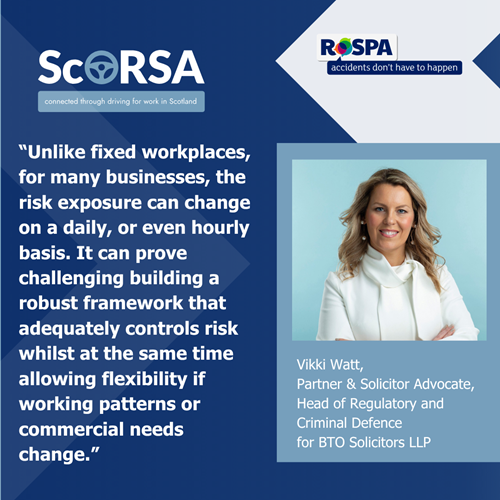
Unlike fixed workplaces, for many businesses, the risk exposure can change on a daily, or even hourly basis. It can prove challenging building a robust framework that adequately controls risk whilst at the same time allowing flexibility if working patterns or commercial needs change.
Employees are invariably working remotely, without direct management supervision. The risks are multi-faceted; driver fitness and competence, fatigue, distraction, time pressures, vehicle maintenance and adverse weather to name but a few.
The growing use of “grey fleet” vehicles also presents difficulties, requiring employers to ensure that privately owned vehicles used for business purposes are appropriately maintained, insured and fit for purpose. Commercial pressures and unrealistic schedules can provide fertile ground for unsafe behaviours to grow, making leadership commitment and a positive safety culture critical.
How can effective incident reporting and investigation help improve road safety and prevent future collisions?
Effective incident reporting and investigation is vital to effective management of risk and ultimately preventing future incidents. Organisations that investigate not only collisions but also near misses are better able to identify underlying causes that increase risk such as inadequate training, poor journey planning, excessive workloads or weaknesses in existing control measures. By capturing data, analysing trends and sharing lessons learned, employers can implement targeted corrective measures and monitor their effectiveness. This proactive approach helps to reduce risk, improve driver behaviour and continuously strengthen road safety performance. Ultimately, a robust reporting and investigation process is one of the most powerful tools available for reducing occupational road risk and preventing avoidable harm.