Fatigue - Thought Leadership
This month, we asked Fabio Lemes dos Santos, Chartered Ergonomist and Human Factors Specialist at Integrated Human Factors, for his insights.
How significant is fatigue as a workplace health and safety issue today?
Years ago, I ran the ergonomics committee at a General Motors plant in Brazil. We measured everything: reach distances, postures, loads, noise levels. What nobody measured was how people got home after the night shift. That still bothers me. Two decades later, working offshore in the North Sea, I keep finding the same blind spot. Fatigue rarely turns up in an incident report under its own name. It arrives dressed as human error. And for most organisations, driving is still the most dangerous thing they ask anyone to do, while the journey either side of a shift is the part nobody counts as work.
What are the biggest challenges organisations face when managing occupational road risk?
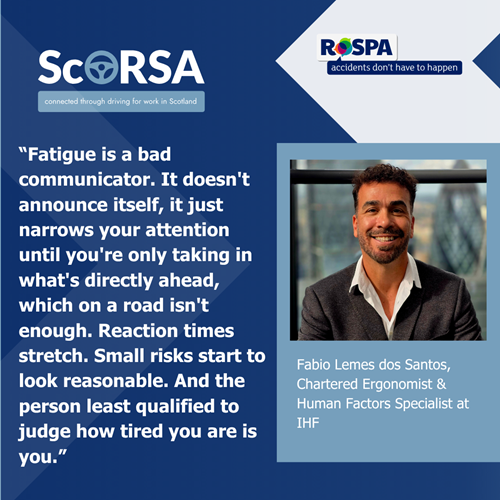
Fatigue is a bad communicator. It doesn't announce itself, it just narrows your attention until you're only taking in what's directly ahead, which on a road isn't enough. Reaction times stretch. Small risks start to look reasonable. And the person least qualified to judge how tired you are is you. There's a physical side as well, which my physiotherapy background won't let me ignore: pain disrupts sleep, poor sleep lowers your tolerance to pain, and people often get into the car already halfway round that loop. Add a twelve-hour shift and the drive home becomes the riskiest thing you'll do all day.
How can effective incident reporting and investigation help improve road safety and prevent future collisions?
Stop treating fatigue as a character flaw. Nobody volunteers to be tired. Look properly at rosters, journey plans and the hours either side of a shift, and be honest about whether the drive home is genuinely the employee's own time. Give people a way to say they're not fit to drive that costs them nothing socially. Then measure it. At IHF we've built BaselineNC, a wrist-worn device that uses anonymised biometric data to flag fatigue before performance drops, rather than after someone writes the report. It's been running with tram and public transport drivers in Edinburgh and Hungary. Think of it as PPE for people who drive.